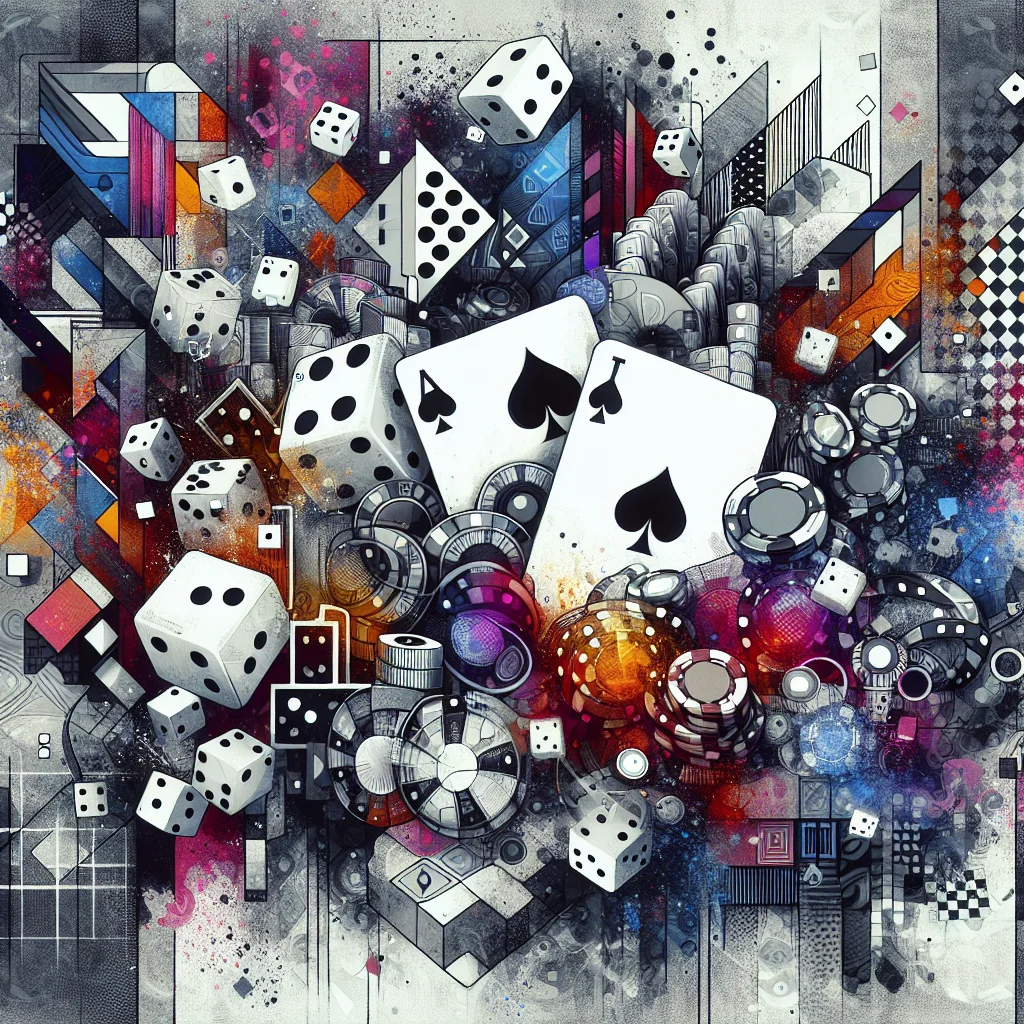
Betting on the Abstract: The Post-War Artistic Wager
As art moved beyond representation in the 20th century, the symbolism of gambling evolved from moral narrative to multifaceted metaphor. Modern and contemporary artists seized upon the visual lexicon of the casino and the card table not to tell stories of individual vice, but to critique broader systems: the randomness of existence, the predatory nature of consumer capitalism, and the high-stakes game of artistic creation itself. The playing card, the dice, and the slot machine lever became readymade icons, stripped of their literal context and repurposed as potent tools for philosophical and social commentary. This artistic shift mirrors society’s own complex relationship with chance, transforming gambling imagery from a subject into a critical language.
Pop Art’s Jackpot: Commodification and Chance
The Pop Art movement of the 1950s and 60s found a natural ally in gambling imagery. Artists like Jasper Johns and Larry Rivers used the familiar iconography of targets, maps, and playing cards to question the nature of representation itself. Johns’ series of “Device” drawings, featuring a ruler attached to a canvas to create semi-random circular marks, invoked the mechanics of chance operations, a conceptual gamble in the studio. For Pop artists, the casino was just another facet of the glittering, mass-produced consumer landscape. The slot machine, with its promise of a jackpot, perfectly symbolized the empty allure of instant gratification and the repetitive, addictive cycle of consumerism.
Claes Oldenburg’s proposed monumental sculptures, like a giant roulette wheel or a set of dice for Las Vegas, highlighted the absurd scale of gambling as entertainment industry. His soft sculptures, which turned hard objects into droopy, vulnerable forms, could be read as a deflation of the casino’s hard-edged, confident glamour. Meanwhile, British Pop artist Derek Boshier directly incorporated betting slips and racing forms into his paintings, framing gambling as an endemic part of working-class life and media saturation. In Pop, gambling wasn’t a moral failing; it was a cultural condition, as ubiquitous and branded as a soup can.
Conceptual Games: Risk as Artistic Practice
The Conceptual Art movement took the relationship between art and chance to a logical extreme, where the idea of the gamble became the very methodology of creation. Influenced by John Cage’s musical aleatory, artists like Sol LeWitt created works based on self-imposed, arbitrary systems—a gamble on the outcome of a predetermined process. His wall drawings, executed by others according to his instructions, relinquished authorial control, betting on the integrity of the concept over the artist’s hand. This was a high-stakes wager on the nature of art itself.
Yoko Ono’s “Instruction Paintings,” such as “Lighting Piece” (“Light a match and watch till it goes out”), invited participants to engage in a simple, temporal act of focused risk. The artwork existed in the fleeting, unpredictable moment. More directly, the Fluxus group, with artists like George Brecht, created “Event Scores” that were essentially game-like instructions for mundane actions, blurring the line between life, play, and art. Brecht’s “Drip Music” (for a single source of drops) or “Three Games” turned gallery spaces into arenas of gentle, participatory chance. Here, the artist was not a creator of objects but a dealer of conceptual possibilities, inviting the audience to place their own bet on meaning.
Neo-Expressionism and the Dice of Identity
The raw, figurative intensity of Neo-Expressionism in the 1980s saw a return to gambling motifs charged with new psychological and political angst. Artists like Jean-Michel Basquiat used the crown, the copyright symbol, and skeletal figures alongside cryptic text, creating a visual language of street-smart survival where life was a high-risk game. His work “CPRKR” references the champion boxer, another gladiator of chance, while the fragmented, scrambled words evoke the unstable odds faced by a Black artist in a white-dominated art world. The gamble was for legacy, authenticity, and cultural capital.
Similarly, the German painter Anselm Kiefer incorporated lead, straw, and other coarse materials into his monumental works, gambling with the very physical integrity and longevity of the artwork. His themes of history, mythology, and destruction presented human civilization as a reckless wager with fate. For these artists, the dice were cast by history, identity, and trauma. The gaming table was the world stage, and the stakes were existential. The chaotic, aggressive application of paint itself became a performative risk, a bet on the emotional payoff of gesture and material.
The Contemporary Installation: Immersive Systems of Luck
Today’s contemporary artists create immersive environments that turn viewers into active participants in systems of chance. Carsten Höller’s giant slides and sensory experiments, like his “Decision Corridors,” literally architect choice and mild risk, making the gallery visit a physical gamble. His work “Roulette Table” is a functioning, beautifully crafted table that stands as a minimalist sculpture until used, highlighting the object’s dual nature as both functional gaming device and aesthetic icon.
Interactive digital art and AI-generated pieces push this further. Artists like Rafael Lozano-Hemmer create installations where participant input—a heartbeat, a voice—determines a unique, ephemeral visual outcome. This is gambling with biometric data. The rise of NFTs and crypto-art has explicitly fused art markets with speculative finance, making the collecting of digital art a volatile, high-risk investment. Artists engaging with this space are acutely aware they are playing a new kind of market roulette. From Damien Hirst’s “The Currency” project, which forced buyers to choose between a physical painting or its NFT, to digital worlds where virtual casinos exist as art pieces, the contemporary scene fully integrates the metaphors of chance, value, and speculation into the very fabric of how art is made, sold, and experienced. The chip is now both medium and message.