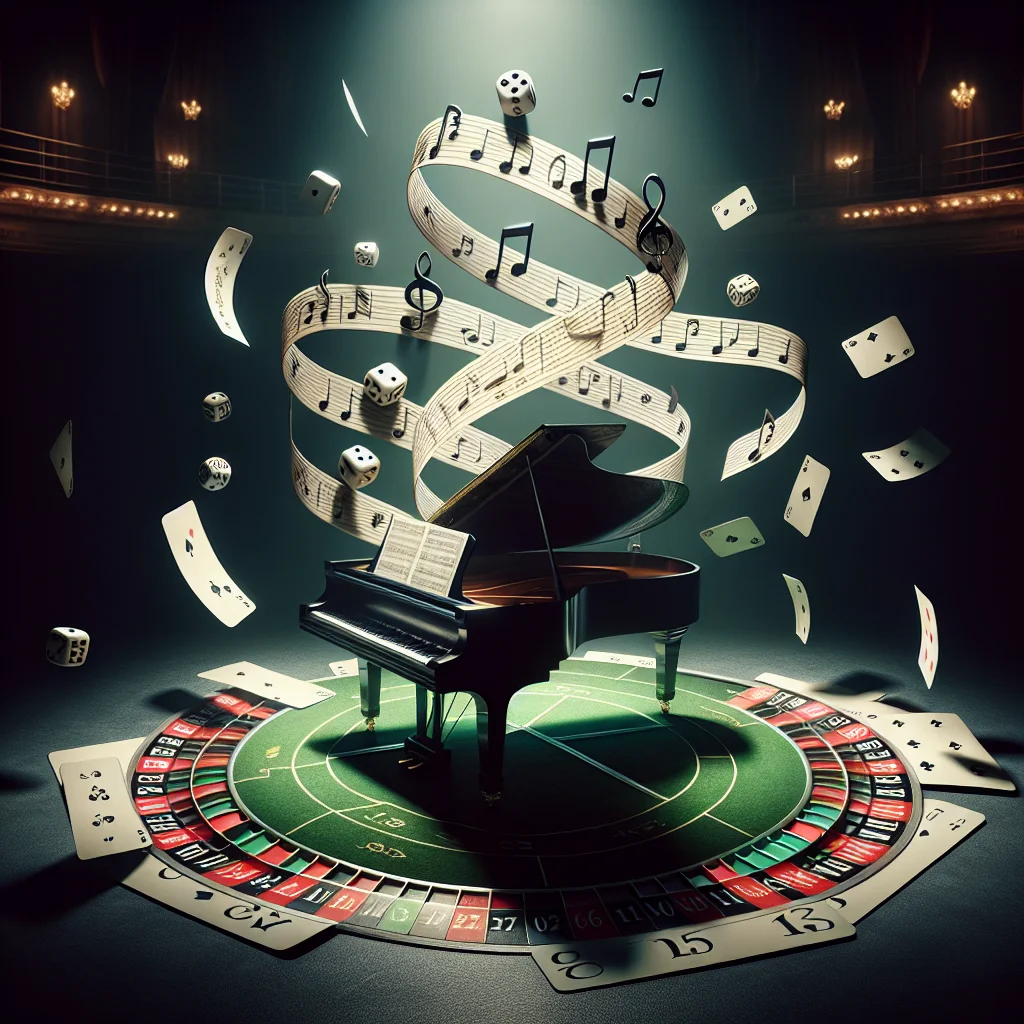
Overture to Fortune: Music’s Dance with Destiny
Beyond the librettos of opera, the very language of instrumental music—its rhythms, harmonies, and dynamics—has proven a perfect medium to capture the essence of gambling. Composers have long been fascinated by the inherent drama of chance, translating the spin of a wheel, the turn of a card, and the emotional rollercoaster of the gambler into pure sonic form. From the elegant salons of Paris to the bustling theatres of Vienna, musical works inspired by games of risk offer a unique auditory window into the psychology of luck, anticipation, and loss. These compositions do not merely describe gambling; they sonically embody its suspense, its mania, and its poignant melancholy, allowing listeners to feel the gamble in their very bones.
The Card Table as Concert Hall: Ravel’s Precise Shuffle
Maurice Ravel’s “Jeux d’eau” might celebrate water, but his fascination with games found its purest expression in works inspired by cards. While not explicitly about gambling, his “Sonatine” and the orchestral textures in “Daphnis et Chloé” showcase a composer obsessed with precision, clarity, and intricate structure—qualities akin to a skilled card player’s strategy. The true masterpiece, however, is his opera “L’enfant et les sortilèges,” where a torn wallpaper reveals a pastoral scene featuring a duet between two cats whose meows sound suspiciously like a jazzy, dissonant card game, a whimsical yet sophisticated musical pun.
More directly, the early 20th century saw composers explicitly titling works after card games. Erik Satie, with his characteristically quirky genius, wrote “Le Piège de Méduse,” which includes the “Jeu de Cartes” movement. The music is deliberately mechanical and repetitive, mimicking the shuffling and dealing of cards with a sense of detached, almost absurdist ritual. This approach strips the gamble of its glamour, presenting it as a mundane, yet oddly compelling, human activity. The music’s sparse textures and unresolved harmonies leave a feeling of chance hanging in the air, an unanswered musical question.
Roulette Wheels and Rhythmic Fate: The Pulse of Chance
Perhaps no game is more musically evocative than roulette. The spinning wheel, the bouncing ball, the final click into a numbered slot—this is a ready-made percussion concerto. Composers have used rhythmic devices to mimic this fateful spin. Igor Stravinsky, a master of complex rhythm, infused his “Capriccio for Piano and Orchestra” with sudden, jarring accents and unpredictable metric shifts that feel like the ball hopping unpredictably between pockets. The listener is kept in a state of rhythmic anticipation, never quite settling into a comfortable groove, mirroring the gambler’s tense wait for the wheel to stop.
In a more programmatic vein, contemporary composer Michael Daugherty’s “Dead Elvis” for bassoon and chamber ensemble includes a movement titled “Roulette Royale,” a frenetic, pulsing piece that uses repetitive minimalist patterns layered with chaotic, improvisatory bursts. The bassoon becomes the lone gambler’s voice, weaving through a mechanized, relentless casino soundscape. The music builds to a climax that doesn’t resolve but simply stops abruptly—the sonic equivalent of “rien ne va plus” and the final, decisive outcome. This use of rhythm and texture creates a powerful auditory metaphor for a system that is both orderly (the wheel’s spin) and chaotic (the ball’s path).
The Dice of Dissonance: Aleatory Music and Controlled Chaos
The mid-20th century saw the ultimate fusion of music and chance through the development of aleatory, or chance, music. Pioneered by composers like John Cage, this genre literally incorporates elements of randomness into the composition or performance. Cage’s “Music of Changes” uses the I Ching, an ancient Chinese divination text, to determine musical parameters. While not about gambling per se, it philosophically aligns with surrendering to chance, making the composer a kind of cosmic gambler. The performer, too, engages with elements of uncertainty, akin to a player accepting the roll of dice.
Other composers applied this more directly to gaming themes. Karlheinz Stockhausen’s “Klavierstück XI” presents the pianist with 19 segments of music that can be played in an order chosen in the moment, a musical game with a different outcome each time. The listener experiences a unique “performance gamble.” Similarly, game theory influenced the works of composers like György Ligeti, whose “Études pour Piano” contain incredibly complex rhythmic structures that feel like solving a perilous, high-stakes puzzle. The connection is clear: the thrill of navigating musical risk mirrors the thrill of the wager, celebrating the beauty and tension found within systems of chance and skill.
From Waltzes to Jazz: The Social Dance of the Gamble
Gambling has also inspired music that captures its social and atmospheric context. The waltz, a staple of 19th-century ballrooms and casinos, is intrinsically linked to the genteel risk of the card table. The music of Johann Strauss II, though not explicitly about gambling, provided the soundtrack for an era where high-stakes games were a social pastime among the aristocracy. The elegant, swirling triple meter of the waltz mirrors the social dance of bluff and counter-bluff, the graceful concealment of tension.
In the 20th century, jazz and blues absorbed the gambling ethos completely. While this belongs more to popular music, its influence bled into classical compositions. Darius Milhaud’s “La création du monde” drew heavily on jazz idioms to depict a chaotic, creative genesis, a kind of cosmic gamble. The improvisatory spirit of jazz, where musicians “bet” on their next melodic idea, is itself a form of artistic gambling. This cross-pollination shows how the concept of chance is a universal musical principle, from the structured randomness of a dice game in a concert piece to the spontaneous risk-taking of a jazz solo. Through these diverse works, composers remind us that music, at its core, is a bet on emotion—a gamble that a particular sequence of sounds will resonate, move, and ultimately, pay out in human feeling.