Dealing with Morality: Art’s Early Warnings
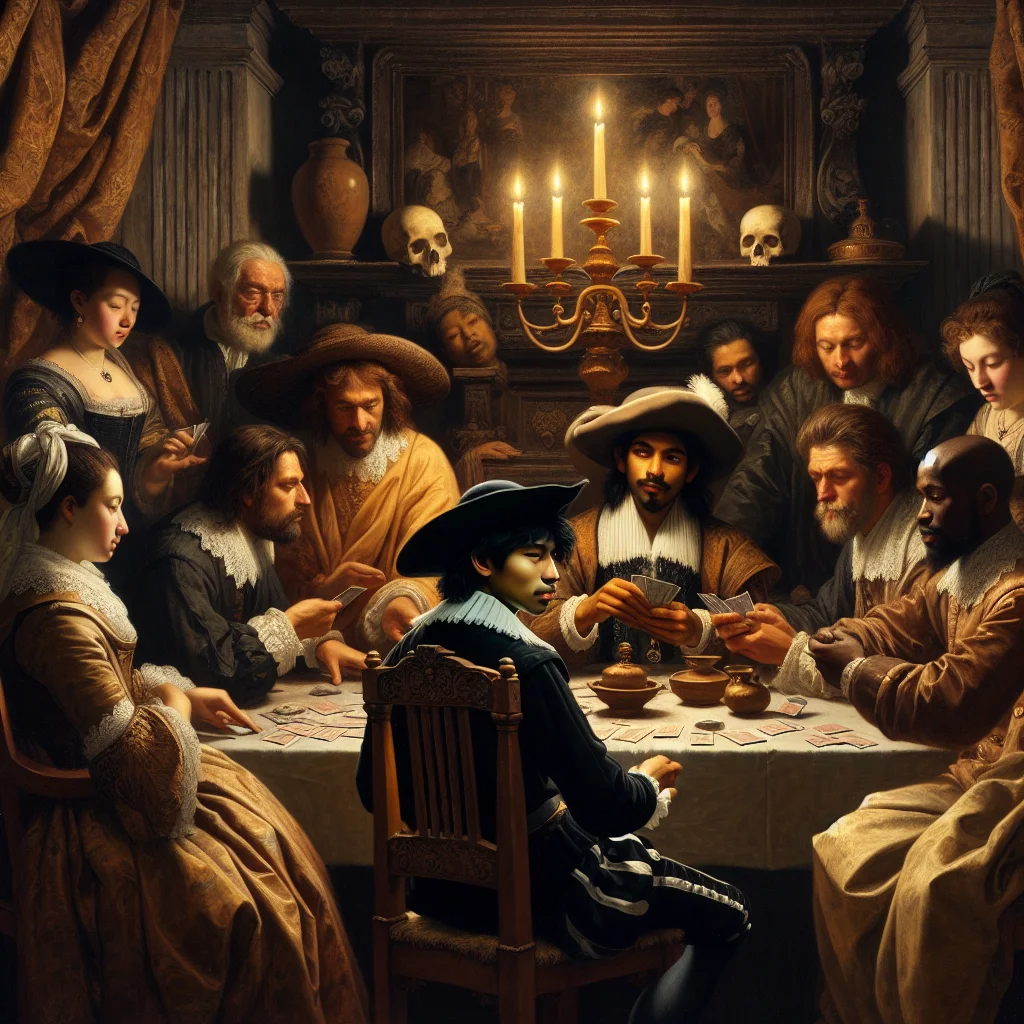
Long before casinos glittered, the gaming table was a powerful stage for moral instruction in Western art. During the Renaissance and Baroque periods, artists employed scenes of card playing, dice rolling, and other games of chance not as mere genre depictions, but as complex visual sermons. In an era deeply concerned with salvation, virtue, and the transience of earthly life, gambling became a potent metaphor for spiritual risk, foolish choices, and the devil’s work. These paintings, rich in symbolic detail, were designed to be “read” by viewers, offering layered narratives about the dangers of deceit, idleness, and placing one’s faith in worldly fortune rather than divine providence.
The Vanitas of the Wager: Life as a Fleeting Game
Deeply connected to the “Vanitas” genre, gambling scenes served as stark reminders of life’s brevity and the folly of earthly pursuits. In still-life and genre paintings, a deck of cards scattered next to a skull, an extinguished candle, or a wilting flower was a clear message: just as a winning hand is temporary, so too are wealth, beauty, and life itself. The Dutch Masters, in particular, excelled at this symbolic language. A painting by Jan Steen or Pieter de Hooch might show a seemingly convivial domestic scene, but a closer look reveals a child blowing bubbles (a symbol of vanity) or a map on the wall (worldly concerns) as gamblers focus intently on their cards.
The cards and dice themselves were symbols. Dice, with their reliance on pure chance, represented the unpredictable and often cruel hand of fate. Cards, requiring some skill but still subject to luck, symbolized the interplay between human agency and fortune. A toppled wine glass amidst the game signaled the disorder and sin that followed such activities. These elements combined to create a clear moral calculus: time spent gambling was time stolen from pious or productive work, a misallocation of one’s brief mortal span. The viewer was meant to walk away contemplating their own spiritual “wagers,” encouraged to bet on eternal salvation rather than temporal gain.
Caravaggio’s Theatrics of Deceit: The World as a Con Game
No artist dramatized the peril of the gamble more viscerally than Michelangelo Merisi da Caravaggio. His “The Cardsharps” (c. 1594) is a landmark work that transformed the subject. Gone are the generic moralizers; in their place is a gripping, psychologically acute narrative of real-time deception. The painting captures the moment a naive, well-dressed youth is cheated by two conspirators. The older cardsharp peers over the boy’s shoulder, signaling his partner’s hand with a gesture behind his back. The tension is palpable, the lighting dramatic, isolating the actors on a dark stage.
Caravaggio’s genius was to make the allegory immediate and human. The gamble here is not just for money, but for innocence and trust. The young man’s fate is a warning to the viewer: the world is full of sophisticated traps, and vice often wears a friendly face. Caravaggio’s use of chiaroscuro—the stark contrast of light and shadow—morally illuminates the scene, highlighting the deceitful hands and the victim’s vulnerable face. This wasn’t a generalized warning about sin; it was a specific, thrilling lesson in street-smart survival, suggesting that life itself was a high-stakes game where one must beware of hidden cards.
Bosch’s Hellish Dice: Gambling as Sinful Folly
Earlier, in the Northern Renaissance, Hieronymus Bosch populated his apocalyptic visions with gambling as a symptom of mankind’s moral decay. In his triptych “The Garden of Earthly Delights,” particularly in the right panel depicting Hell, gambling is portrayed as a demonic, futile activity. Damned souls are shown engaged in chaotic games, often with monstrous creatures, on unstable tables that are part of the torturous architecture of Hell itself. For Bosch, gambling was a literal sin, a diversion that led the soul away from God and into eternal punishment.
His work “The Ship of Fools” also features figures engaged in idle, foolish pursuits, including gambling, as they drift aimlessly. In Bosch’s symbolic universe, the dice and cards are tools of distraction, keeping humanity from navigating the true path to salvation. The act of gambling is stripped of any glamour or excitement; it is rendered as absurd, compulsive, and ultimately self-destructive. This aligns with medieval and early Renaissance religious teachings that viewed games of chance as inherently sinful, an invitation to greed, sloth, and wrath—a direct challenge to divine order where providence, not luck, should govern one’s life.
The Social Mirror: Genre Scenes and Class Commentary
Beyond direct allegory, these paintings also functioned as sharp social commentary. Artists like the Le Nain brothers in France or David Teniers the Younger in Flanders painted gambling peasants and soldiers. These scenes could be read in two ways: as a warning to the upper classes about the dissolute behavior of the lower orders, or as a more empathetic, if still moralizing, look at the pastimes of the common man. The settings—dark taverns, military encampments, rustic interiors—emphasized gambling as a vice of idleness and poor environment.
Conversely, paintings of the aristocracy gambling, though rarer, carried a different critique. They hinted at the corruption and idleness of the upper classes, who had the leisure for such dangerous pursuits. The expensive clothing and refined settings contrasted with the base nature of the activity, suggesting a moral hollowing-out beneath a veneer of sophistication. Whether depicting peasants or nobles, the Renaissance and Baroque artist used the gambling table as a diagnostic tool, a place to examine the health of the soul and the state of society, proving that centuries before psychology or sociology, art was conducting a profound inquiry into the human propensity to risk it all on a turn of the card.